


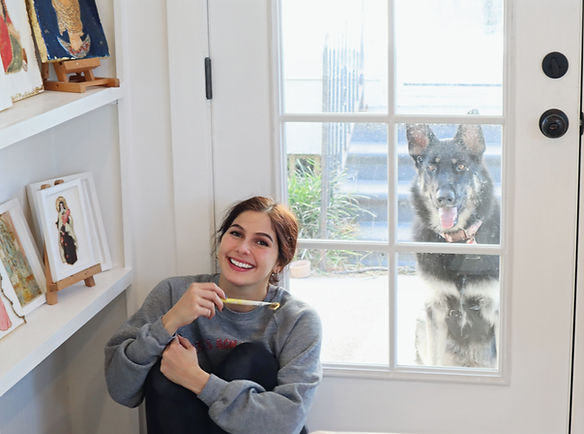
My name is Rachel. I am a self-taught artist who works primarily with mixed media and gouache paint. I delight in making art with shiny stuff I find.
My artwork for the most part is devotional. I am humbled that I get to use my gifts to inspire prayer and conversation with God. I love making stuff that helps people connect more deeply with their faith and their relationship with Our Lord and the communion of saints.
I studied English at The Catholic University of America in Washington, DC. This was one of the most formative experiences for my soul. I love, love, love the role of narrative and lyric in our storied lives.
I studied theology and pastoral leadership at Notre Dame Seminary in New Orleans. I make art in a little home studio in the River Parishes. My German Shepherd puppy, Hilde (short for Hildegard) keeps me company when I paint
I also contribute to a little arts journal called Joie de Vivre, where my passions for literature, theology, and art synthesize to celebrate the beauty of the bayou. JDV is a publication of The St. Louis IX Art Society down in Louisiana
If you are connected with a particular devotion or patron saint, let me know--I would love to paint something to help inspire you in your faith life!


![The word “eucatastrophe” inspired so much of my depiction of Our Lady’s triumphant Immaculate Heart. The lively, sanguine springtime flowers would not be so lovely had they not been watered by Our Lady’s tears.
Love in its purest form is not sentimental, but is, as Fydor Dostoevsky puts it in The Brothers Karamazov, “a harsh and dreadful thing.” Those words are made so real in the Seven Sorrows that pierce Our Lady’s heart.
But no matter the harsh and dreadful reality love demands, we are still called to witness the trials of heartbreak with a distinctly Christian joy–not a sentimental or naive expression of joy, but a joy that considers how the suffering on this side of heaven is not our final end.
Coined by J.R.R. Tolkein, “eucatastrophe” is the sudden and mysterious consolation of a happy ending. It is, despite all odds, the good catastrophe, the happy disaster that summons a sudden turn brought about by grace.
Tolkein tells us, “[Eucatastrophe] does not deny the existence of dyscatastrophe, of sorrow and failure: the possibility of these is necessary to the joy of deliverance; it denies (in the face of much evidence, if you will) universal final defeat and in so far is evangelium, giving a fleeting glimpse of Joy, Joy beyond the walls of the world, poignant as grief.”
Even while pierced by the Seven Sorrows, Mary’s Immaculate Heart exemplifies this evangelium and shows us how to embrace our own suffering in the context of eucatastrophe, giving a glimpse of the joy that, as Tolkien says, “produces tears because it is qualitatively so like sorrow, because it comes from those places where Joy and Sorrow are at one, reconciled, as selfishness and altruism are lost in Love.”
Our hope, satisfied by joy, comes from the truth that no suffering–not even death–can defeat the opportunity for redemption. Our Lady witnesses the eucatastrophic Beatitudes so beautifully: “Blessed are they who mourn: for they will be comforted…Rejoice and be glad, for your reward will be great in heaven” (Matt 5:3-12).
Original painting available here:
https://www.rachpaintsart.com/product-page/immaculate-heart-of-mary
#marianart #resinart #neworleansartist #catholicart #totustuus](https://scontent-den2-1.cdninstagram.com/v/t51.82787-15/753686280_18124076207508348_5125284829250844451_n.jpg?stp=dst-jpg_e35_tt6&_nc_cat=107&ccb=7-5&_nc_sid=18de74&efg=eyJlZmdfdGFnIjoiQ0FST1VTRUxfSVRFTS5iZXN0X2ltYWdlX3VybGdlbi5DMyJ9&_nc_ohc=D4Glcl65OqsQ7kNvwHIrmpF&_nc_oc=AdpuCQSrD1_y_KQeRQ_cbi2ZINxHUCy2ljGThp8zs3ZPPUskfq4z39_ehqJRq89I5XM&_nc_zt=23&_nc_ht=scontent-den2-1.cdninstagram.com&edm=ANo9K5cEAAAA&_nc_gid=TX5ii1a7xWgsafoXWYuVaw&_nc_tpa=Q5bMBQKxxx54-IrSHsHXf1s4VIuC3ztHoVh7r6sUp0casH4Ojl7f-Xsdxy-zhBJ5Z42Os-5sNOV4aTzj&oh=00_AQKjsRoXcqnozOKmQV8ywo6ALe5SVIjIfP4p7EW9_gPS0A&oe=6AB9D672)


